



Chord Patterns
Welcome to chord patterns - Chord patterns are the way songs are made. The most common chord pattern is the 1-4-5-1 pattern found in all types of music. A chord is two or more notes held at the same time. The most common chord is the triad three notes held at the same time. The 1, 3 and 5 notes make up the major one chord - see The Major Scale to learn note numbers.
Chord patterns also known as Diatonic Harmony are easy and fun to practice. Here are a few of the more common chord patterns.
Examples 1
1 - 4 - 5 -1 Chord Pattern
aka
I - IV - V - I Chord Pattern
Key of C the chords are: C - F - G - C
Key of D the chords are: D - G - A - D
Key of E the chords are: E - A - B - E
Examples 2
1 - 3 - 4 - 2 - 1 Chord Pattern
aka
I - iii - IV - ii - I Chord Patterns
Key of F the chords are: F - A - Bb - G - F
Key of G the chords are: G - B - C - A - G
Key of A the chords are: A - C# - D - B - A
Examples 3
1 - 6 - 2 - -5 - 1 Chord Pattern
aka
I - vi - ii - V - I Chord Patterns
Key of B the chords are: B - G# - C# - F# - B
Key of Db the chords are: Db - Bb - Eb - Ab - Db
Key of Eb the chords are: Eb - C - F - Bb - Eb
Key of Gb the chords are: Gb - Eb - Ab - Db - Gb
Examples 4
1 - 2 - 3 - 4 - 5 - 1 Chord Pattern
aka
I - ii - iii - IV - V - I Chord Patterns
Key of Ab the chords are: Ab - Bbm - Cm - Db - Eb - Ab
Key of Bb the chords are: Bb - Cm - Dm - Eb - F - Bb
Again notice how at the top of the example it show roman numerals and then the chord names for the key below try to think in numbers theres much less to think about and your doing yourself a favor.
At Diatonic Harmony I have a chart that shows how chord patterns can work using chord numbers 1-4-5-1 instead of chord names ( C-F-G-C). Please have a look its very easy and has been a great great tool for me.

About Diatonic Modes
In a Scale you can start on the first note of the scale and call it the 1 tone or you can change Diatonic Modes and start on the second note of the scale and call it the 1 tone. This leads to big confusion so its a good idea to have a look at Diatonic Modes to get a picture in your head. It's very easy once you see it.

By Michael Pelletier
How to Use the Circle of Fifths for Creating Killer Chord Progressions
If you're a musician, producer, or songwriter, you probably already know that creating killer chord progressions is an essential part of the music-making process. One tool that can help you with this is the Circle of Fifths. In this article, we'll take a deep dive into the Circle of Fifths and explore how you can use it to create amazing chord progressions.
What is the Circle of Fifths?
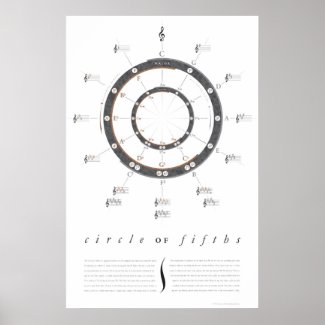
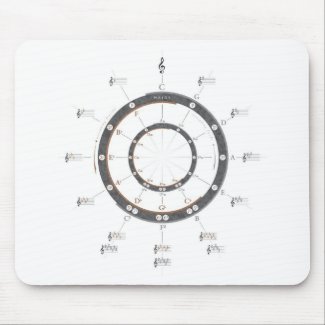
The Circle of Fifths is a visual representation of the relationship between the 12 notes in the Western music system. It's called the Circle of Fifths because each note is a fifth apart from the previous one as you move around the circle. The Circle of Fifths is a useful tool for musicians because it shows the relationships between the different keys and scales in music.
Understanding the Circle of Fifths
To understand the Circle of Fifths, you need to know a little bit about music theory. In Western music, there are 12 different notes, which are arranged in a repeating pattern called an octave. The notes are named A, A#, B, C, C#, D, D#, E, F, F#, G, and G#. Each note is a half step apart from the next one.The Circle of Fifths is based on the relationships between these 12 notes. If you start on C, which is the note in the middle of the circle, and move clockwise around the circle, you'll move up a fifth each time. So the next note is G, which is a fifth above C. The note after G is D, which is a fifth above G, and so on.

How to Use the Circle of Fifths for Chord Progressions
Now that you understand the basics of the Circle of Fifths, let's explore how you can use it to create killer chord progressions. One of the most common chord progressions in Western music is the I-IV-V progression. In the key of C, this progression would be C-F-G.To use the Circle of Fifths for chord progressions, start by choosing a key. Let's say we want to write a song in the key of G. Find G on the Circle of Fifths and then look at the notes immediately to the left and right of it. These are the notes that are a fifth below and a fifth above G.The note a fifth below G is D, and the note a fifth above G is C. These notes, along with G, form the I-IV-V chord progression in the key of G, which is G-C-D.You can use this same method to find chord progressions in any key. Start with the note you want to use as the root of your chord progression and look at the notes a fifth below and a fifth above it. These notes will form the I-IV-V chord progression in that key.
Conclusion
The Circle of Fifths is a powerful tool for musicians, producers, and songwriters. By understanding the relationships between the different keys and scales in music, you can use it to create killer chord progressions that will take your music to the next level. So if you're looking to up your music game, take some time to study the Circle of Fifths and see what you can come up with!
Understanding the Basics of the Circle of Fifths
Before we dive into how to use the Circle of Fifths for music production, let's review the basics. The Circle of Fifths is a diagram that shows the relationships between the twelve notes of the chromatic scale, their corresponding key signatures, and the chords that are commonly used in each key. The circle is arranged in a clockwise pattern, with each note a fifth above the previous one.At the top of the circle is the note C, which has no sharps or flats in its key signature. Moving clockwise around the circle, each new key signature adds one more sharp or flat to the scale. At the bottom of the circle is the note F#, which has six sharps in its key signature. Moving counterclockwise around the circle, each new key signature adds one more flat to the scale.Using the Circle of Fifths to Create Harmonic Progressions
One of the most common uses of the Circle of Fifths in music production is to create harmonic progressions. A harmonic progression is a sequence of chords that creates a sense of movement and tension in a piece of music.
The Circle of Fifths can be used to navigate between different keys and create smooth and cohesive harmonic progressions. For example, a common technique is to start in one key and then move to the key a fifth away. By using the Circle of Fifths as a guide, music producers can easily navigate between different keys and create interesting and dynamic harmonic progressions.
Using the Circle of Fifths for Chord Progressions
One of the most useful applications of the Circle of Fifths in music production is for creating chord progressions. Because the circle shows the relationships between different chords and keys, you can use it to find chord progressions that sound good together. Here's how: 1 Choose a key: Start by choosing a key that you want to write your chord progression in. You can choose any key, but for this example, let's use the key of C major. 2 Identify the chords: Look at the Circle of Fifths and find the key of C major. The chords in the key of C major are C, Dm, Em, F, G, Am, and Bdim. 3 Choose your progression: Once you know the chords in your key, you can choose a chord progression. For example, you could use the progression C - G - Am - F. 4 Experiment with other progressions: The Circle of Fifths can also help you experiment with other chord progressions. For example, you could try the progression G - D - Em - C or Am - F - C - G. 5 Explore different keys: You can also use the Circle of Fifths to explore different keys and find chord progressions that work well in those keys.
Choose a key: Start by choosing a key that you want to write your chord progression in. You can choose any key, but for this example, let's use the key of C major.
Identify the chords: Look at the Circle of Fifths and find the key of C major. The chords in the key of C major are C, Dm, Em, F, G, Am, and Bdim.
Choose your progression: Once you know the chords in your key, you can choose a chord progression. For example, you could use the progression C - G - Am - F.
Experiment with other progressions: The Circle of Fifths can also help you experiment with other chord progressions. For example, you could try the progression G - D - Em - C or Am - F - C - G.
Explore different keys: You can also use the Circle of Fifths to explore different keys and find chord progressions that work well in those keys.
Understanding Tonality and Key Signatures
Another important use of the Circle of Fifths in music production is to understand tonality and key signatures. By looking at the circle, you can see the relationships between different keys and the chords that are commonly used in those keys. This can help you understand the overall feel and mood of a piece of music, and can also help you create more interesting and complex melodies.
Conclusion
The Circle of Fifths is a powerful tool for music producers. By understanding the relationships between different chords and keys, you can create chord progressions that sound good together and understand the tonality and mood of a piece of music. Experiment with different chord progressions and keys using the Circle of Fifths, and see how it can help you create better music.